I did not plan to leave posting about the saints for so long. TIme passes so quickly when you are having fun, and running ultra marathons. In retrospect I should have put Bartlett’s entries up daily on the Facebook group devoted to the descendants of William Despain. These posts could have then been more supplementary to the project. I think I could have scheduled posts that way too. Lessons learned.
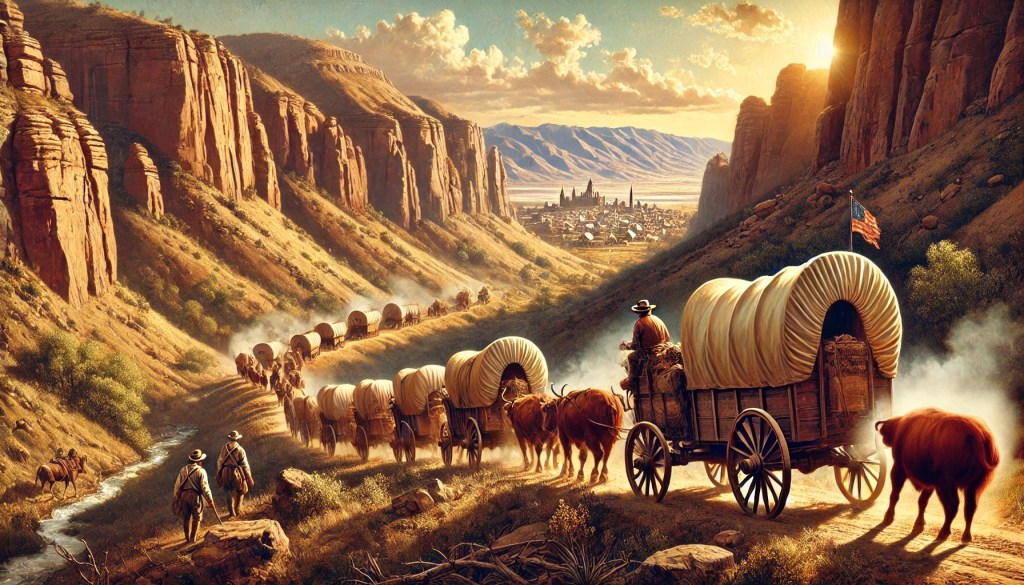
It turns out that Bartlett’s journal ends today. On August 7th, Bartlett leaves the saints to forge ahead with his brother to the Salt Lake Valley. 5 days later he arrives in the city. The rest of the company does not arrive for another 4 days, on August 16th. The entire crossing taking some 78 days to complete.
The last couple weeks sees the saints bury two more people on the trail, an elderly man, and a child. We read about soldiers and politicians, and catch glimpses of bigger historical narratives surrounding our company. It is hard to know exactly how far the saints travelled. Bartlett was not perfect in recording the distance travelled each day. I believe they travelled about 890 miles, or 1425. kilometers. How did I do? I am about 300 miles or 500 kilometers behind at the moment. I anticipate I’ll roll in behind them around the end of August (mid-September at the latest). They set a hard pace. When Bartlett breaks away from the company at the end, he sets an average daily distance of about 35 miles or 56 kilometers. We’ve gotten soft in the age of the automobile.
I wish I had something poignant or profound to say here at the end of this trek. I wasn’t able to give this project the attention it truly deserves, but this is just a beginning. I’ll continue to read about, and explore, the lives of my ancestors. I’m grateful for them, for all they endured. I hope my cousins that read these posts will feel a little more connected to their past and a little kinship with me. I’ll leave you for now with the final entries of our friend, Bartlett Tripp.
Friday 26th
We set out early and ascended a high, sandy bluff. The road was good for many miles, although we passed several dry creeks. We had dinner by the river, about a mile west of the station. We camped one mile east of Three Forks, where the feed was good. The Texan camp was just below us.
Saturday 27th
We stayed in camp for the forenoon due to the death of one of our group, an elderly man named Cheney, who had been unwell since we left Florence. He likely passed from Mountain Fever. He was a well-loved and respected man, and his death leaves a void among his family and friends. It seems especially hard to bury loved ones on the plains, far from the graves of civilization. His grave was dug wide at the top, with several shelves of earth as it was dug down, shaped like a coffin. A board above and below the body, clothed in appropriate garments, was his only protection from the damp earth. The grave was then covered with rocks to protect it from wolves. In the afternoon, we passed the Three Crossings of the Sweetwater River, which winds through lofty, overhanging mountains inscribed with the names of many travelers. The road from there was high and gravelly, passing away from the river for several miles before descending back to it, where we camped for the night.
Sunday 28th
The day was clear and cool. We set out early, crossed the river, and traveled on the south side for the rest of the day. We had dinner at the Ice Springs, located in a long valley through which the road passes for some distance. From there, we drove to the river, about 12 miles away, and camped on the north side, where we found an abundance of wild gooseberries.
Monday 29th
We made a steep ascent from the river, which we rejoined after 2 miles. We forded the river twice near South Pass City, where we stopped for dinner. The city consists of a ranch with the usual log outbuildings. We crossed part of Rocky Ridge, which I think is little better entitled to the name than many other ridges we’ve passed. We camped 1 mile to the left of the road and 1 mile north of the Sweetwater River in a small valley with plenty of feed but no water. The days are warm, but the nights are exceedingly cold. We haven’t seen snow for several days.
Tuesday 30th
The road was hilly but hard and gravelly. We passed Strawberry Creek, where there is a station, and had dinner on a branch of the Sweetwater River. We found more excellent gooseberries, similar to those cultivated in the States. The creek is clear and swift-moving, with willows growing along its banks. The descent on either side of the creek is steep. The road then led through high, rolling country. We camped on the Sweetwater at the upper ford, where there is a station and a blacksmith shop. The feed was short, having been grazed by previous emigrants.
Wednesday 31st
Several teams were delayed, searching for their cattle. Through South Pass, the water begins to flow westward. The elevation is 7,084 feet. We had dinner at Pacific Springs, 1 mile west of the station. The feed was good, but the ground was miry and would shake at a great distance, though the turf seemed tough. We camped 2 miles to the west, on a road turning left into a fine meadow where the feed was excellent, but the water was poor.
Thursday, August 1st
The day was very warm. We stayed in camp to let the cattle rest and feed. Three mule teams, Jolleys and Dreemer, drove out this morning for the city with more speed. The Texas Company, which we left at South Pass City heading to Utah, came into camp this morning. Mr. Cummings, who stayed behind at the Platte Bridge, came in tonight and reported that Mr. Wilcox’s daughter is better and the remainder of the company is rolling on. The camp was busy with ox shoeing and repairs.
Friday 2nd
We set out early. The road was the same as usual across this country—gravelly. We passed Dry Sandy, where there was little water, and what water there was, was brackish, with no feed. We camped on Little Sandy, where we found the three wagons that had driven out yesterday, awaiting their lost mules. This was the longest drive we’ve had without feed or water—24 miles.
Saturday 3rd
Mr. Robert Thomas lost a little girl last night to Mountain Fever. She was buried this morning. She was a cripple and not of sound mind; the loss of such a child is never to be mourned. We had dinner on Big Sandy, which is little better than the stream we camped on last night. The road passes along this river at a distance of 1 to 2 miles. We camped on Big Sandy, 1 mile from the road. There was no bottom feed, just bunch grass.
Sunday 4th
We started late. The road was hilly. We passed a creek where the Mormons burned the soldiers’ wagons; the ashes still mark the outlines. We had dinner at the 2-mile crossing of Big Sandy, where the grass was excellent. There was a station being built and some very strong alkali pools. A smart shower made the bottoms very muddy, with clay ground. We camped at Green River quite late, where there was plenty of grass and wood, and the first cottonwood trees we’ve seen since leaving the Platte.
Monday 5th
We moved only across the river. The ford was deeper than usual, so we blocked up the wagon beds. All crossed safely, although several showers struck just as the last wagon reached the far side. The river rose considerably during the day. Mr. Hooper, a delegate to Congress from Utah, passed through with a train on the way home. In the evening, we had a log fire, around which speeches were made and stories were told until late.
Tuesday 6th
We were late getting on the road. I met my brother, who had come out to meet me, about 7 miles from Green River. We loitered along at our pleasure and came into camp with the company at Ham’s Fork. Some of the company didn’t arrive until late. There were smart showers around noon and again in the evening. We found old man Sanderson here, who had missed the road at Pacific Springs and was waiting for the company. I will now go on with my brother, leaving the office of clerk to Brother Cannon, having recorded thus far the incidents, events, and descriptions as I usually do in my own journal.
Wednesday 7th
I got my things from Mr. Barzee’s wagon and continued on with my brother. I paid Mr. Barzee $11.00 for bringing my belongings this far. We had dinner on Black’s Fork. The train came up before we left, and we received their best wishes for a safe arrival at the city. We crossed Smith’s Fork at Millersville Station and camped about 4 miles west, on the fork. Two men on their return with grocery wagons, along with gentlemen Stewart and Robinson, camped with us. Robinson is the owner of the ferry at Green River. We put our animals on an island formed by a creek and the fork.
Thursday 8th
We started early and met the gentlemen with their oxen just east of Bridger, where they had strayed. We crossed the South Fork at Bridger, which is a station for soldiers, consisting of several blockhouses, stables, stockhouses, and so on. The soldiers here are from Camp Floyd, returning to the States to participate in the war. We had dinner on a small spring creek 2 miles east of Muddy Fork, with a rocky descent, and crossed another small creek, Muddy. We passed Copperas Spring and Winding Ridge and camped near Quaking Aspen Station. The mules grazed on bunch grass. The spring water was brackish. Mr. Sant, Mrs. Mustard, Mr. Tanner, and the Freight Company camped with us. The distance covered was 32 miles.
Friday 9th
We set out at 6:30 and passed a fine spring on the left side of the road while descending from the station. Sulphur Creek was nearly dry. We crossed Bear River, which has a swift current and clear water. There was a station on the west side. We had a long ascent of 3 miles and stopped for dinner at Yellow Creek, at the foot of a rocky bluff hanging frightfully over the road. There was a station there. After a 2-mile ascent, we encountered a severe shower at the summit, getting some of us wet. We camped at Cash Cove, 6,070 feet above sea level, at the head of Echo Canyon, which the road now enters. We set up camp about 4 miles from the next station to the west, during another evening shower. Mr. Perry, with two wagons, joined our camp. The distance covered was 38 miles.
Saturday 10th
We started out at 4 AM, passing a soldier’s baggage train. One of our wagons broke an axle about 8 miles in, so we stopped to have breakfast while Mr. Peary and Enoch fixed the axle. Once ready, we started again and exited Echo Canyon at Weber River, following it for a mile before turning to the left. We had dinner about 12 miles up the river. One of our mules showed symptoms of a cold, so we bled her in the mouth and continued on. After a long, winding ascent, we arrived at the summit of the river and began to descend into another canyon, which brought us to Canyon Creek, a cold mountain stream. The roads were good except in some springy places. The mule’s condition worsened, so we camped about 2 miles up the creek. Mr. Perry’s wagons continued on. There were plenty of willows, currants, and service berries along the creek. The distance covered was 33 miles.
Sunday 11th
The mule was better, so we drove up about 6 miles to have breakfast at the east foot of Big Mountain. We reached its summit through a winding canyon. The west descent was very steep. We had dinner on Little Mountain and arrived in town around 5 PM.
 MacAdventures.ca
Leave a comment